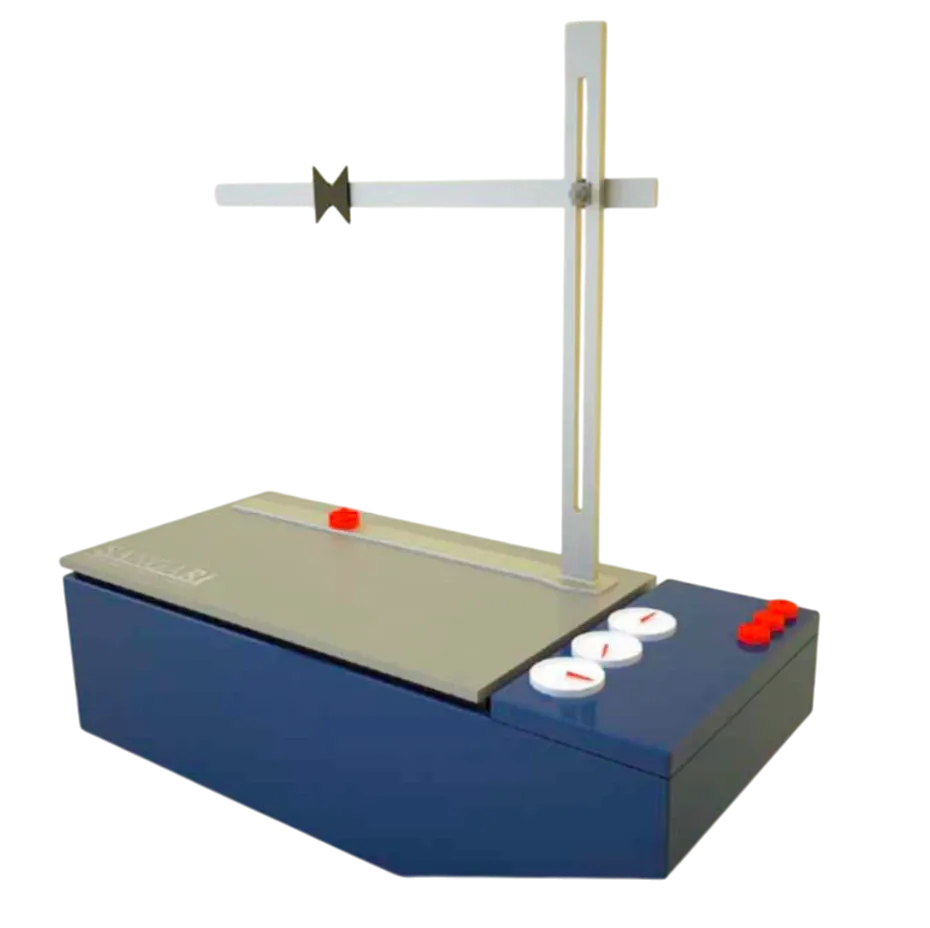
Free jet apparatus for velocity profile, centreline decay and momentum flux measurements
Experiments
Measurement of the velocity profile across a round turbulent free jet discharged into still air
Decay of the centreline velocity as a function of axial distance from the nozzle exit
Radial spread and development of the jet — growth of the jet half-width with axial distance
Pressure distribution at the outlet of a parallel flow into stationary surroundings
Analysis of the velocity profiles to show that mass flux increases, kinetic-energy flux decreases and momentum flux remains constant along the jet
Effect of the fan speed on the jet exit velocity and on the extent of the jet core
Use of a Pitot tube and micro-manometer for velocity measurement via the dynamic pressure
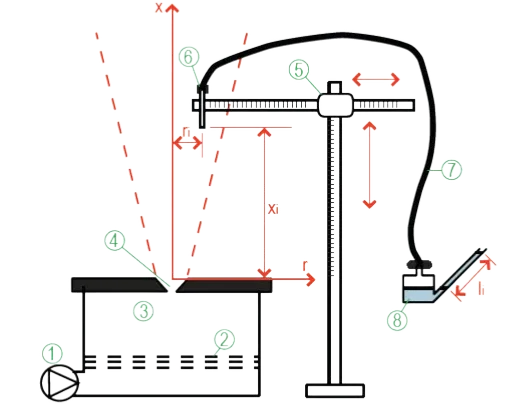
fan
flow straightener
air plenum chamber
nozzle / orifice
traverse mechanism
Pitot tube
flexible hose
micro-manometer
Description
An axial fan feeds a plenum chamber; the flow is straightened through a honeycomb/screen pack and discharged through a round nozzle into still laboratory air, forming a round turbulent free jet.
A Pitot tube mounted on a two-axis traverse moves axially along the jet and radially across it, reading the total pressure at any point. Connection via flexible hose to a
sensitive micro-manometer gives the dynamic pressure, from which the local velocity is computed.
Because the jet and the surrounding air have the same density (air into air), the apparatus demonstrates the classical momentum-integral behaviour of a free jet — constant momentum flux,
decaying centreline velocity, and self-similar radial profiles — in a direct, visual experiment.
Features
Self-contained free-jet apparatus — fan, plenum, nozzle and traverse mounted on a single frame
Flow straightener (damping screen / honeycomb) for a uniform, low-turbulence jet at the nozzle exit
Round nozzle discharging horizontally into still air — classical free-jet geometry
Two-axis Pitot-tube traverse — axial along the jet and radial across it, with precise position readout
Sensitive micro-manometer for accurate dynamic-pressure measurement at low jet velocities
Variable fan speed for operating over a range of jet Reynolds numbers
Clear, scale-ruled traverse suited to plotting axial and radial velocity profiles directly
Measurement principle
Local velocity is obtained from the dynamic pressure read by the Pitot tube: v = √(2·Δp / ρ)
Integration of the radial velocity profile at successive axial stations gives the mass, momentum and kinetic-energy fluxes of the jet
Direct plotting of velocity profiles against axial and radial distance illustrates the self-similar structure of a turbulent free jet